
Weaving AI into the Fabric of Work

Building on my friend’s comment that I shared beneath my previous post, and on the comment from Ms. Filiz, I built the core of this piece around one question: “We understand the middle layer. But how can I, as a marketing specialist, bring AI into my daily work?”
The question looks practical, but a deeper issue lies beneath it.
The first truth is this: nearly all marketing professionals already use AI. HubSpot’s 2026 State of Marketing research, conducted with more than 1,500 professionals, says marketing is going through its biggest upheaval in twenty years, because AI is no longer one of the options on the table; it is the table itself. The point that same research underlines is this: in 2026, the difference lies not in who uses AI, but in how they use it.
What’s more, AI isn’t only on the producing side. According to the same research, half of consumers now use AI-powered search, and half of Google searches come with an AI summary. In other words, the tool is everywhere: on the table, both on our side and on the customer’s.
Yet sticking a tool on top of the work is not the same as weaving it into the fabric of the work. And this is where the real question lies: if the tool is everywhere, why isn’t the value everywhere yet?
Everyone Uses It, Few See Value
At first glance, the picture looks like a success story. According to McKinsey’s 2025 State of AI research, 88 percent of organizations regularly use AI in at least one business function, and marketing and sales are the areas where revenue growth is most frequently reported. However, the same research also reveals a second, more uncomfortable truth: only a third of organizations have managed to scale AI across the enterprise, while the remaining two thirds are still in the pilot stage. Moreover, only 39 percent report any impact of AI on EBIT, and for most of them that impact stays below 5 percent.
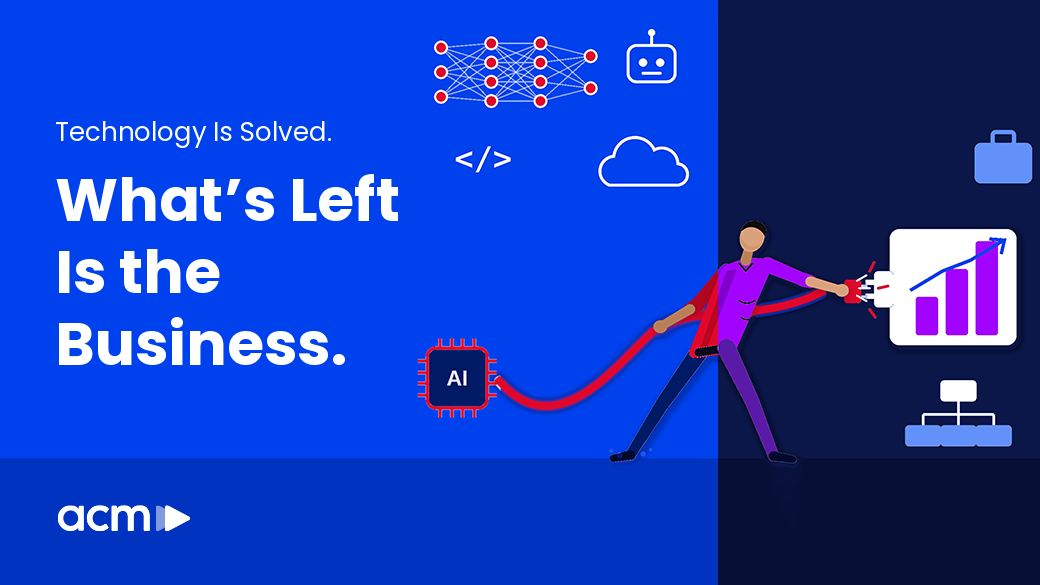
What the numbers say is clear: AI has become ordinary, but because most organizations haven’t embedded it deeply enough into their workflows, they aren’t seeing a meaningful return at the enterprise level.
As I’ve noted a few times before, there is one success factor that sets high-performing organizations apart from the rest: redesigning the workflow.
A Faster Typewriter
Most marketing specialists use AI to do the work they already do, faster. AI writes the draft, AI produces the summary, AI prepares the report. Same work, just faster.
This is using AI like a faster typewriter. The typewriter genuinely sped up writing; but it never decided what should be written. When you use AI this way, production speeds up, but decisions stand still. The typewriter is sticking the tool on top of the work; value, on the other hand, comes from weaving it into the fabric of the work, that is, from re-weaving the work itself.
The painful part emerges when everyone uses the same typewriter. In HubSpot’s research, 83 percent of respondents say that, with AI, they are expected to produce more than ever before. The workload isn’t shrinking; on the contrary, it’s growing: roughly a quarter of participants say their workload has increased significantly, and nearly half say it has increased moderately. AI didn’t lighten the work; it raised the expectation of output.
A faster typewriter gives no one an advantage when everyone has the same typewriter.
The Sameness Trap
One of HubSpot’s marketing leaders sums up the result plainly: most content today is no longer produced by people but by AI, yet most of that content is mediocre. Indeed, more than half of marketing professionals say they struggle to differentiate their content in a market flooded with AI.
When everyone uses the same tools with the same default outputs, marketing drifts toward a single average: the same tone, the same angle, the same “AI voice.” HubSpot’s CMO Kipp Bodnar says that in an era where AI is reshaping marketing, the real differentiator is taste: a unique perspective on your audience and a genuine understanding of what they need and which experiences they’re missing.
Taste is not the output of a tool; it is born from a person’s own perspective and accumulated experience.
Three Zones
The right way to place AI into your day isn’t a list of tools; it’s a decision map. You can position every task in your daily work in one of three zones on this map.
Zone one: the automation zone
Mechanical, easily reversible tasks that require no judgment belong here: generating draft variations, summarizing a long report, formatting data, running a first round of desk research. Here, AI can be in the driver’s seat, because the cost of error is low and control remains with you.
Zone two: the thinking-together zone
In this zone, AI proposes and you decide. Segment hypotheses, campaign angles, and possible interpretations of an analysis take shape here. AI opens ten doors for you; which one you walk through is your call. So here, AI is not an intern, but a thinking partner.
Zone three: your zone
This is where irreducible judgment lives: the brand’s voice, positioning, what is worth saying, what is true, the ethical line, and the trust built with the customer. These are things that don’t fit into a spreadsheet; and that is exactly why they must remain yours.
These three zones are the desk-level version of the decision architecture from my previous piece. The question is no longer “Which tool should I use?” but “Which of my day’s decisions belong to AI, and which belong to me?”
A Day in the Life of a Marketing Professional
Let’s make it concrete. In the morning, AI summarizes the data that accumulated overnight, social listening signals, and campaign metrics, and puts them in front of you; this is the automation zone. Which signal matters and what you’ll focus on today, however, is your decision; that decision stays in your zone.
During production, AI suggests five headlines, three opening paragraphs, and a few visual directions. You shape the voice, the rhythm, and what truly belongs to the brand.
During analysis, AI flags the pattern behind a drop in conversions. You read the context behind that drop, whether it points to campaign fatigue or to a message wearing thin.
Throughout the day, AI is constantly at work, but the decision architecture stays with you.
So…
The answer to “How can I bring AI into my daily work?” isn’t an app, a plug-in, or a shortcut. The answer lies in the question you ask yourself every morning when you sit down at your desk: Which of today’s decisions belong to AI, and which belong to me? Speeding up the typewriter is easy. The real work is that you still decide what gets written.
Sources
- Mandy Bray, “2026 State of Marketing: Data from 1,500+ Global Marketers” — HubSpot, güncelleme 10 Nisan 2026. https://blog.hubspot.com/marketing/hubspot-blog-marketing-industry-trends-report
- Darrell Etherington, “HubSpot’s CMO on How AI Will Mess With Marketing Metrics — and Why That’s Exciting” — The Angle, 3 Eylül 2025. https://www.theangle.com/p/hubspots-cmo-on-how-ai-will-mess
- Alex Singla, Alexander Sukharevsky, Bryce Hall, Lareina Yee, Michael Chui, “The State of AI in 2025: Agents, Innovation, and Transformation” — McKinsey & Company (QuantumBlack), 5 Kasım 2025. https://www.mckinsey.com/capabilities/quantumblack/our-insights/the-state-of-ai



Comment(s)