
Not Doing the Same Work with Fewer People: Redesigning Work with the Pod

In my first post, I introduced the Pod: a transformation mechanism that redesigns workflows for the age of AI. In this post, I want to show how this approach works against a problem I’m encountering more and more often in the field: teams forced to reorganize with shrinking capacity.
What I’m Seeing in the Field
Particularly in manufacturing and automotive organizations, a recurring pattern has emerged lately: no new hiring, no one replacing those who leave, organizations constantly being restructured, and vacated responsibilities being handed over to the remaining team members. Past a certain point, this inevitably turns into a productivity crisis.
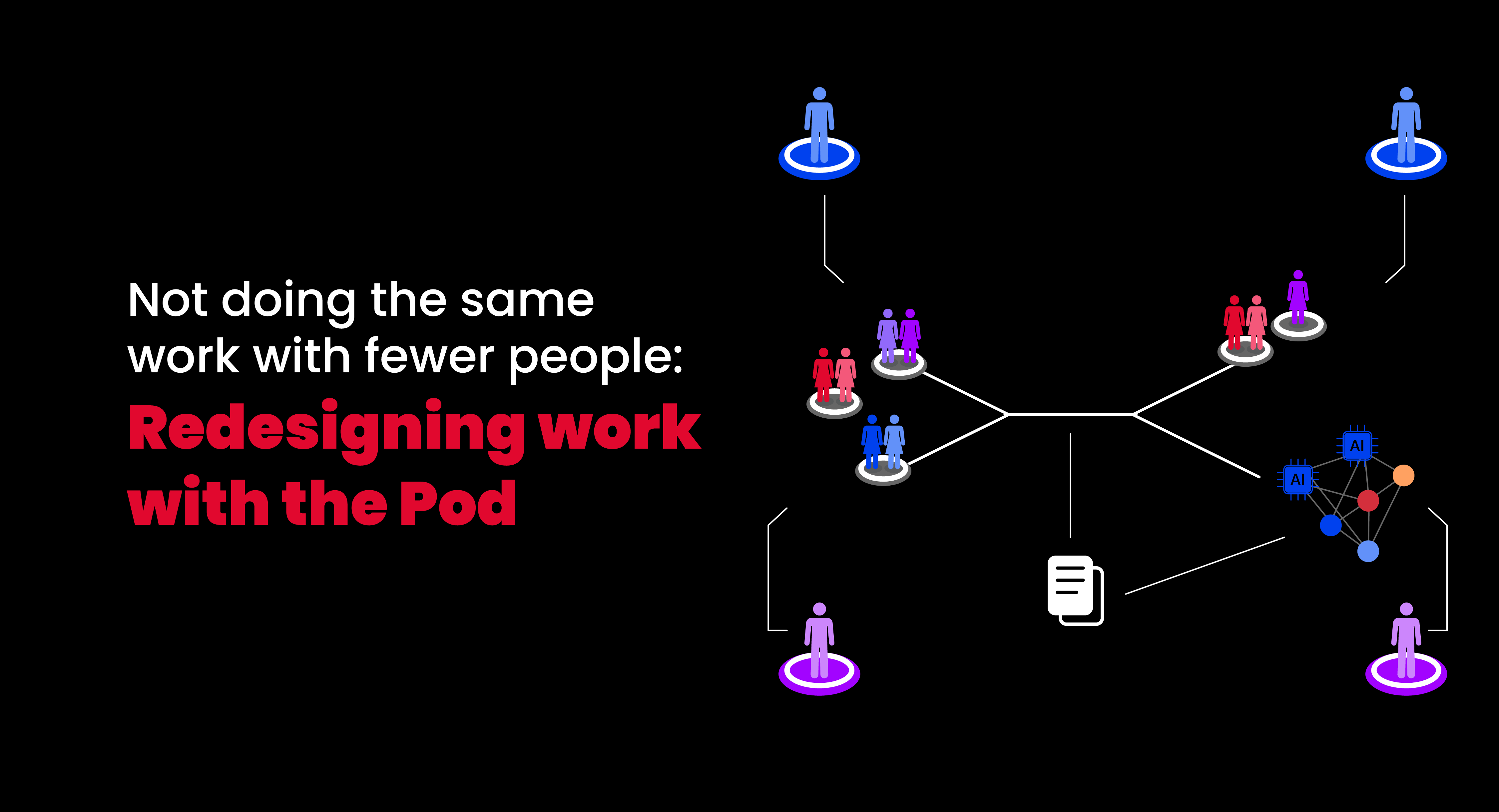
But this isn’t the Pod’s reason for being; it’s just one of the areas where the Pod works especially well. Because the most common mistake in this situation is trying to keep doing the same work with fewer people. What a shrinking team needs isn’t to fill the gap left by the people who are gone. It’s to redesign the work so that human and AI capacity are used together.
First Remove, Then Simplify, Then Redivide
The Pod’s job is not to directly substitute for lost capacity. The sequence matters:
First, you decide which work should no longer be done at all: duplicate checks, approval steps that no longer create value. Next, the remaining workflow is simplified. Only then is a new human-agent division of labor designed, in which repetitive, knowledge-intensive tasks that can be decided within defined boundaries are handed to AI agents, while decisions requiring critical judgment, accountability and human interaction remain with people.
An example: in a downsized team managing product change requests, the goal isn’t to run the same approval process faster. The Pod can eliminate duplicate checks, have an agent compare technical documents and draft an impact analysis, and involve experts only in critical engineering decisions. This way, AI doesn’t speed up the existing bottleneck; it changes the workflow itself.
How the Four Roles Work on This Question
The Value Architect selects the most critical workflow; the Agent Architect designs the human-agent division of labor; the Forward Deployed Engineer makes this design work by integrating it with existing systems; and the Transformation Sponsor removes decision barriers and ensures the new way of working takes hold.
This Change Shouldn’t Be Left to Stand Alone
The Pod is an effective transformation mechanism, but if the rest of the organization doesn’t stand behind this approach, it can’t go beyond transforming a single workflow. Leaders’ concrete responsibilities need to be clear:
- Deciding which work will be stopped
- Clearing the way for data and system access
- Defining the authority boundaries of the human-agent division of labor
- Clarifying the success criteria for the first cycle
- Ensuring that a successful design is carried over to other teams
This is also where HR and transformation offices come in: supporting team members’ skill development with the necessary tools and methods is how the success of a single Pod becomes an organizational capability.
There Is a Third Way
The options facing shrinking teams aren’t limited to working harder or doing less. There is a third way: first remove, then simplify, then redivide the work so that people and AI agents work together. That is exactly the Pod’s mission: not managing a capacity gap, but changing the way the organization generates capacity.
In the next post in this series, I’ll cover what should be measured in a Pod’s first cycle and how success should be defined.

Comment(s)