
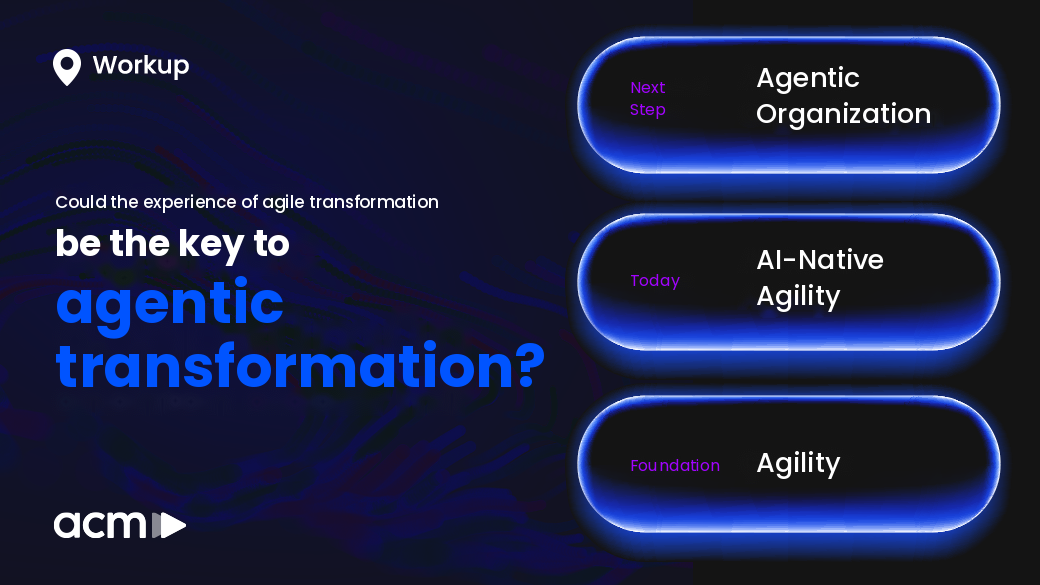
Could the Experience of Agile Transformation Be the Key to Agentic Transformation?

Last week, hosted by Türkiye İş Bankası at WorkUp, we came together with a very special group. There were transformation leaders from banking, telecommunications, retail, insurance, consumer durables, technology and tourism. Every one of them had personally led an agile transformation in their own organization. They had seen the resistance up close, watched rituals gradually turn into purpose, and heard “this time it’ll be different” more times than they could count.
Our agenda was clear: the path from AI-Native Agility to Agentic Organizations.
What did we see in the room?
Throughout the day, we listened to individual company stories. But what stayed with me wasn’t the stories themselves. It was the common pattern running through them.
First, agility isn’t over. Everyone at the table, despite coming from different industries, said the same thing. Agility is still valuable, business units see its benefits, and it has been embraced. AI doesn’t replace this foundation; it’s being built on top of it.
Second, everyone has taken a step. AI assistants embedded in software development processes, support for testing and code review, first agent pilots, AI 101 and 201 trainings, governance models and AI committees that are starting to be written... Most of these steps are still at the level of empowering individuals and teams. There’s still some way to go before reaching the stage of redesigning how the organization itself works.
Third, the most discussed topic wasn’t technology; it was people. Capabilities, the evolution of roles, governance, regulation, trust. In other words, the things that are always the hardest part of any transformation.
The next step is the organization itself
The picture we saw in the room is really the natural starting point of every transformation. In agile transformation, too, we started with teams and experimented with practices, and only after seeing the first successes did we move on to questioning the organization itself. We’re going down a similar path with AI. The foundation built through tools, pilots and trainings is very valuable, because the next step will be taken precisely on top of it.
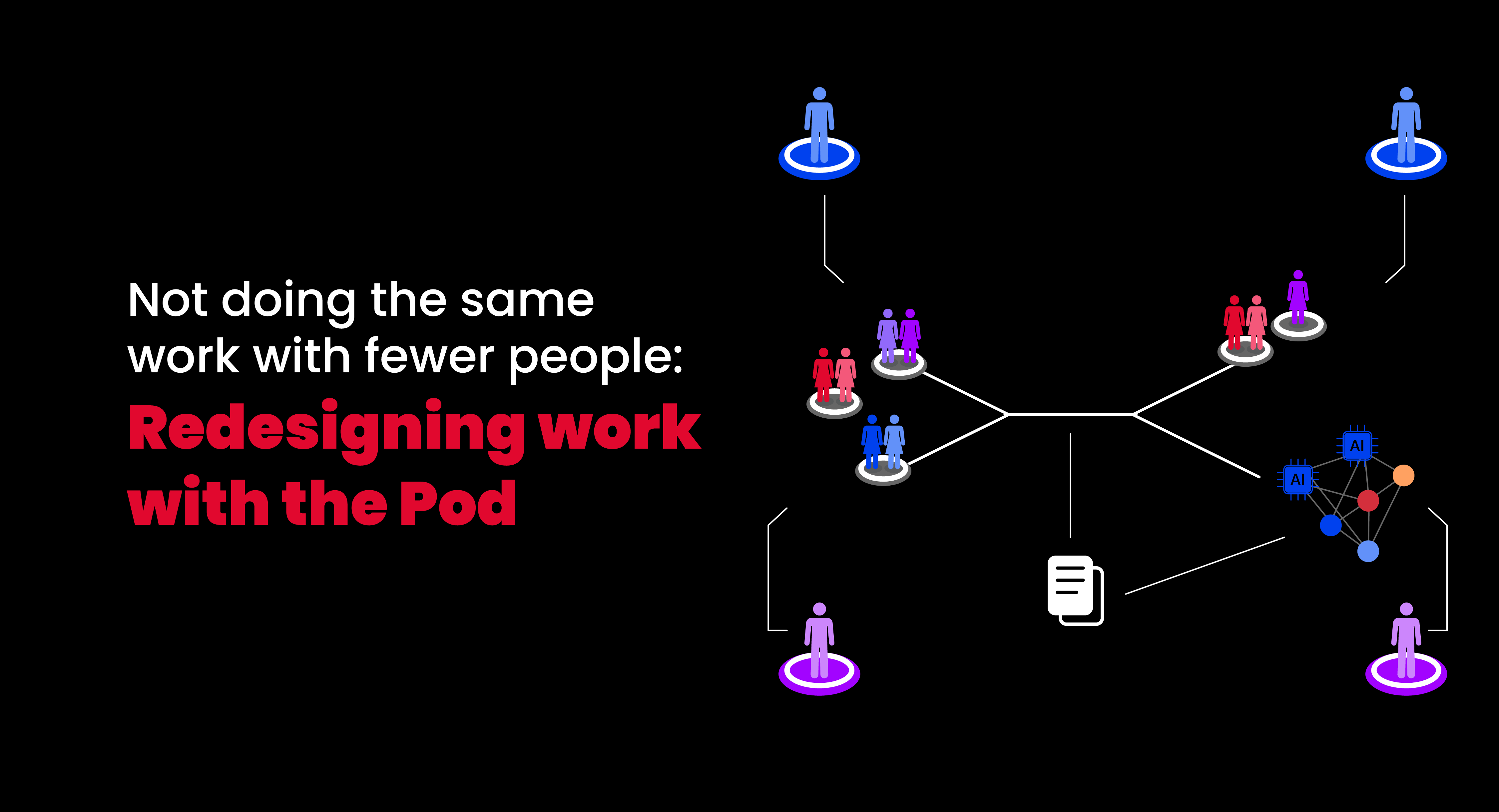
That step is designing a structure in which people and autonomous agents create value together. It means rethinking team design, decision rights, leadership style and governance for this new equation. In other words, it’s a journey that’s more about the organization than about technology.
There’s a sentence we often use at ACM: “Every company still standing by 2030 will have completed its agentic transformation.” I don’t see this as a threat, but as a timeline. The earlier and more deliberately this journey begins, the calmer and more controlled the transition will be.
This is exactly where the opportunity lies
Looking around the room, one thing caught my attention. Many of the muscles needed for this transformation already exist in these teams.
Over the past decade, agile and transformation communities, coaches and transformation offices have learned how to bring a new way of working into an organization. They’ve learned how to manage resistance, scale a pilot, redefine roles and transform culture. That’s exactly what agentic transformation demands.
But on one condition: these teams have to transform themselves as well. A coaching mindset focused on preserving rituals won’t be enough in this new era. What’s needed is a transformation capability positioned as a strategic business partner: one that shares ownership of business outcomes, understands AI, and can design collaboration between humans and agents. Agile teams that can do this may become the most critical transformation leaders of the coming period. Those that can’t may find themselves left outside the very world they describe.
The principles aren’t finished; the work continues
In the second half of the day, we presented the Agentic Organizations Principles, which we want to finalize together with the community. To be honest, not all of our proposal was accepted. Some principles were challenged, some were rewritten, and some are still open for debate.
That’s exactly what we wanted. The principles should be shaped by the debate of the people who will live through this transformation themselves. So we’re continuing the work, and we’ll meet again online with the same group on October 9. Once the manifesto has matured, we’ll share it with you at the Agentic Organizations Summit.
Final word
When I first attended the Agile Türkiye Summit as a participant in 2016, very few people predicted that agility would make it onto the agenda of so many organizations. Today, we’re at a similar threshold for agentic organizations.
The ones who cross this threshold best may not be those with the best technology, but those who best understand the human side of transformation.
We’ll discuss all of these topics, and more, in depth at our 14th summit, the Agentic Organizations Summit, taking place on November 26 at Wyndham Grand Istanbul Levent.
My thanks to all the transformation leaders who joined us and generously shared their experiences and questions, and to İş Bankası for hosting us.



Comment(s)