
Stuck in Bridge Traffic in a Ferrari

To create value at the speed of AI, you have to transform first
In 2024, I had the chance to live in Silicon Valley for about six months. There’s a rule that has always held true for me: spend a few months in the startup ecosystem, absorb the atmosphere, and you’ll see what the world will be talking about a year or two later. Back then, one of the hottest topics in the Valley was AI agents. Today, two years later, agents have become the world’s main agenda. You could even say there’s a serious hype around them.
Recently, in a conversation, we set that hype aside and focused on a single question: has AI really transformed companies? My answer is clear. Companies, not yet. But certain business areas and roles, yes, radically.
Writing code is dead. Making things has been democratized.
The most visible example is probably software. People no longer write code; they direct the AI that writes it. We’re experiencing this firsthand in our own teams. The average developer’s speed has increased perhaps tenfold. For a good developer, one who questions the work and truly understands the problem, the increase is far, far greater.
We’ve started calling this profile an FDE (Forward Deployed Engineer). This is not the engineer who codes whatever task lands on their desk. It’s the engineer who goes into the client’s field, understands the problem on site, and builds the solution together with them. Popularized by Palantir, this role looks set to come up more and more in the AI era. In the Valley in 2024, I heard the phrase “software development is dead” a lot. I didn’t fully understand it then, but today it’s happening right in front of me.
This isn’t just a story about developers, though. The internet democratized access to information. AI is democratizing making. Everyone is becoming able to produce. We’re living through an explosion of what’s popularly called the “maker” world.
Information used to be valuable; then accessing it became easy. Turning information into action used to be hard; now that’s getting easy too. I think it’s inevitable that the radical transformation we’ve seen in software will soon spread to companies. So yes, companies haven’t transformed yet, but they will very soon (they have to, in order to survive).
Two examples from the field
For about four months, we’ve been in the middle of a transformation with Sistem Global. We’re not rolling it out across the whole company at once. Instead, we’re moving “kitchen by kitchen,” as they put it, meaning one business area at a time.
We started with two kitchens: payroll and audit. In both, we’re redesigning how the work is done from scratch and standing up human–agent collaboration. It’s been a short time, but I can say we’ve achieved close to a 25% capacity increase in both areas.
I said making things has gotten faster. With the right approach, transforming has gotten faster too. What does this mean? It means serving 25% more clients with the same team, or redirecting the freed-up capacity to new, high-value services. In other words, it means competitive advantage.
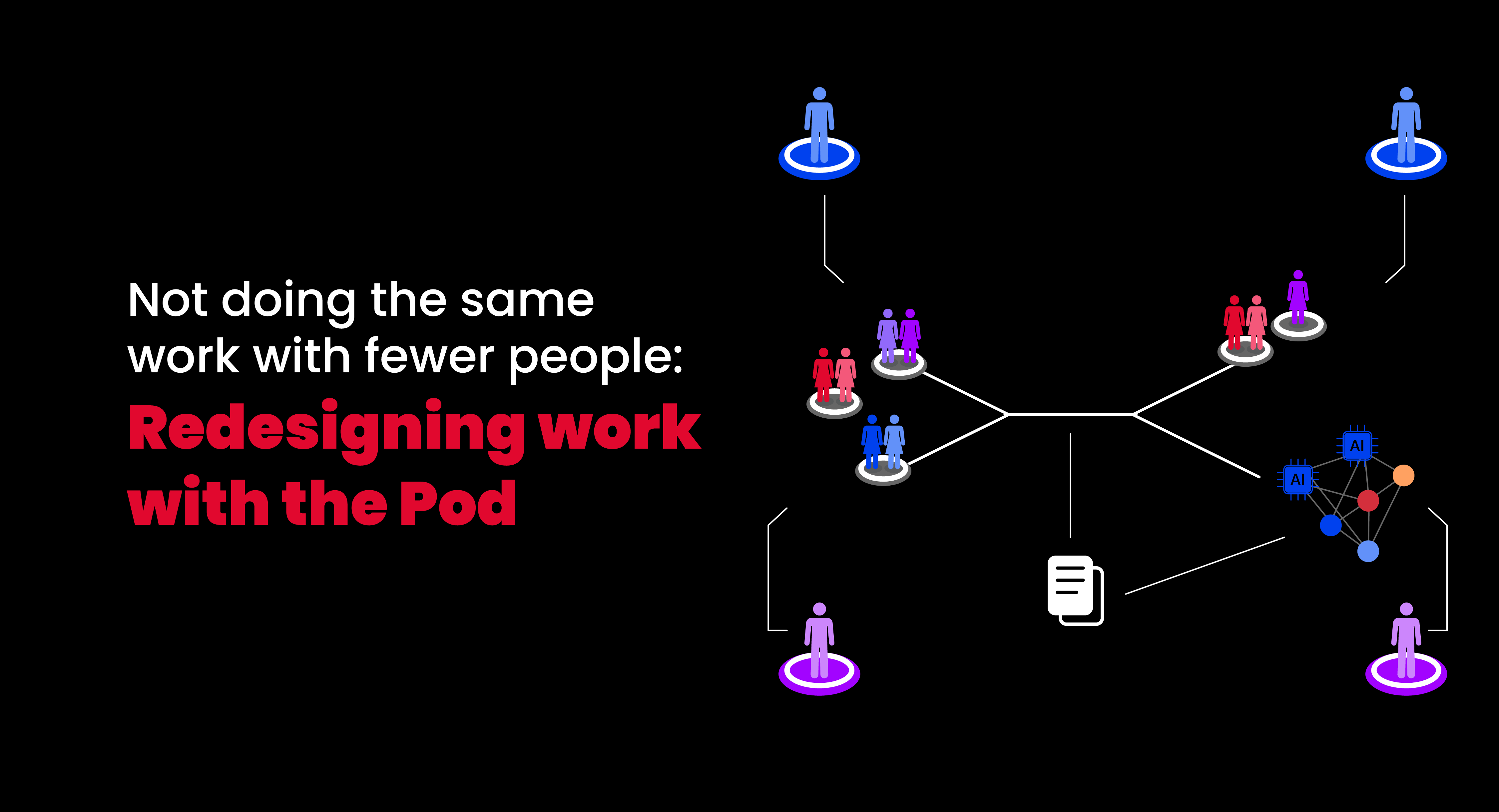
The second example comes from us, at ACM. We run a lot of experiments internally, and we recently set up a revenue growth team: (for now) 3 humans and 4 agents. The agents do market research every week, and together we generate and test hypotheses for products and services that could bring in revenue in the short term.
The team has existed for two weeks. We tested a new service hypothesis that came out of the agents’ research. Within a week, we went from idea to first customer contact, and we got positive responses.
Why does this example matter? To see the difference, I think you have to look back at how things used to be. We’re a 25-person company. In the daily rush, an idea like this most likely wouldn’t have occurred to anyone. Even if it had, it would have died before it came to life. And even if it had come to life, we’d probably have given up after a try or two and said, “It didn’t work.”
This is where the least-discussed quality of agents comes in: persistence. An agent doesn’t get tired, doesn’t give up, and completes the task it’s given. The cycle of generating ideas, testing quickly, learning and seeing results has taken on a completely different rhythm.
Everyone is doing something with AI. Why do so few succeed?
I see this a lot when working with companies. Licenses have been bought, dozens of use cases identified, PoCs completed. But very few of them turn into transformation and value that’s felt across the company.
My observation so far is this: the companies that start seeing results aren’t the ones saying, “Let’s take a look at this AI thing.” They’re the ones in a state of “if we don’t change, we’ll disappear” panic.
To explain the difference, I’d like to go back to a quote from Steve Jobs:
“It doesn’t make sense to hire smart people and then tell them what to do; we hire smart people so they can tell us what to do.”
The same goes for agents. I’m not saying “let agents tell you what to do.” But we have new teammates with a different way of working and a different kind of intelligence. We should approach them the way we’d hire a teammate: they’ll join you, learn and grow.
The “we got an agent, gave it work, let it do it” approach doesn’t work. The real question is this: with this new teammate’s intelligence, what working model can we evolve into so that we can produce more?
Because this isn’t a technology acquisition. It’s a transformation of how work gets done. In my observation, roughly 30% of it is technology and 70% is the transformation of culture and ways of working. We designed our companies on the assumption that people do the work. Now we need to leave that system behind and design a new one for humans + AI.
Driving a Ferrari in bridge traffic
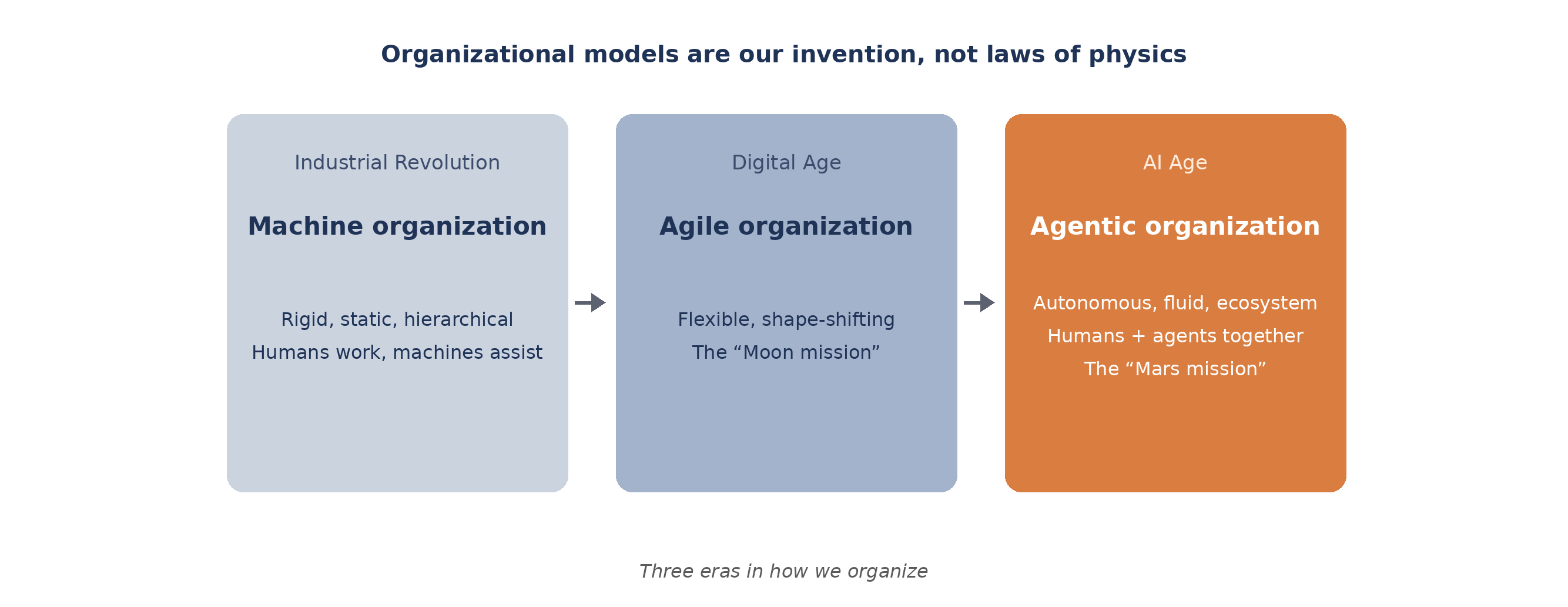
Let’s first remember this: ways of working and organizational models are our own invention. They’re not laws of physics. They can be changed.
The industrial revolution brought the machine organization: rigid, static, hierarchical. The digital age brought agility: structures that can flex and change shape. I see that as humanity’s Moon mission in how we organize ourselves. AI is introducing far more autonomous structures into our lives. Now we’re on the Mars mission.
Now think about the production speed of AI. An agent works overnight, comes in the morning with an action in hand and says, “Go on, decide.” What happens in a classic organization? “Let me ask a manager. There’s an executive committee meeting next week; let’s prepare a presentation. Once it’s approved and if the budget comes through, we’ll move forward.”
That’s like driving a Ferrari in bridge traffic. What a waste of a Ferrari!
The problem isn’t the Ferrari; it’s the road. For the Ferrari to do what a Ferrari does, the organization needs to renew itself around its capabilities.
Otherwise, even the most powerful engine sits idling in traffic. And the bill for that waiting isn’t paid in license fees. It’s paid in missed opportunities.
Five traits of the new organization
I believe we’ll see the following in the organizations of those who rebuild the road:
- Small, even smaller teams. Multidisciplinary structures made up of few humans and many agents.
- Fluid organization. Teams and structures will change shape much more often.
- Ecosystem. The organization won’t consist only of your employees. The connections and partnerships you build with the outside will be your new strength.
- Days, not weeks. Cycles of generating, testing, learning from and improving a hypothesis in just a few days.
- Customer, customer, customer. In a world where everyone can produce and everyone is fast, the ones who make a difference will be those who walk arm in arm with their customers.
We actually watched these traits come to life two weeks ago. At xAI’s 72-hour Grok Bot event, three people sat down with agents and built a company from scratch. At the end of the first day, they pivoted the idea. On the third day, a working, revenue-generating product was live. The number of agents working alongside the three humans grew so much that the team eventually stopped counting.
A small team, a fluid structure, daily cycles, and a customer base born from the audience watching the livestream. All five in one! If you didn’t get a chance to follow it, I strongly recommend reading about the event and watching at least some parts of it, if not all.
Five lessons for leaders
- Transform how work gets done, not the technology. Buying licenses and technology is 30% of the job. The real work is in the remaining 70%.
- Hire agents as teammates, not tools. Don’t just hand them tasks; redesign how you’ll work with their intelligence.
- Clear the road first. If your decision speed can’t keep up with the agent’s production speed, every technology you buy will sit in traffic.
- Start area by area. Don’t take on the whole company at once. Redesign one area end to end and measure the result.
- Get closer to the customer. As making things gets cheaper, value shifts to the bond you build with your customer.
One last question
Today, almost every company is chasing a Ferrari: new models, new licenses, new agents.
But the real question is a different one:
Are you investing in AI, or in an organization that can keep up with its speed?


Comment(s)