
The Agent Use-Case Backlog: A Leader’s Roadmap in the Age of AI Agents

The success of agent projects lies not in the technology, but in the discipline of choosing which work to hand over to an agent.
These days, the same question comes up in every board meeting: “What are we going to do with AI agents?” At most companies, the answer turns out to be a handful of disconnected pilot projects, demos that are quietly shelved within a few months, and disappointment.
The problem isn’t the technology. The problem is the lack of discipline in choosing what work to give agents.
The product management world solved this problem years ago: the backlog. A prioritized, justified, and continuously updated list of work to be done. Now it’s time to apply the same discipline to AI agents: the Agent Use-Case Backlog.
What Is an Agent Use-Case Backlog?
In its simplest form: a structured, scored, and prioritized inventory of the work an agent could take on in your organization. Not an idea pool, but a living management tool in which every entry has a defined business value, data readiness, risk, and owner.
The difference is critical. An idea pool says, “Let’s build a chatbot.” A backlog says: “40% of return requests in customer support come from three standard scenarios; an agent that resolves these scenarios end to end would free up 800 support hours per month. The data is ready, the risk is low, and the owner is the Director of Operations.”
“Agent strategy is about choosing the work before choosing the technology.”
How Do You Fill the Backlog? Three Sources
1. Process pain points. Ask your teams a single question: “What part of your week is spent on repetitive, rule-based work that still requires attention?” Invoice reconciliation, proposal preparation, application pre-screening, order tracking... This is the agents’ natural hunting ground.
2. Customer touchpoints. Every moment a customer is waiting is a use-case candidate. Response times, order status inquiries, frequently asked questions, onboarding steps. The success of Intercom’s Fin came precisely from here: the busiest, most repetitive, most measurable touchpoint.
3. Data-rich areas nobody looks at. Leads rotting in the CRM, unread customer feedback, unanalyzed contracts. Agents create new value by processing data that has been ignored because human capacity couldn’t keep up.
What Should Every Backlog Entry Include?
Before adding a use case to the backlog, fill in these six fields. If you can’t, the idea isn’t mature yet:
- Job definition: What work will the agent do, for whom, and with what trigger? (“For the sales team, when a new lead comes in, it researches the company and prepares a summary and recommendation.”)
- Value hypothesis: What is the measurable gain? Hours, cost, revenue, NPS — pick a single metric.
- Data readiness: Is the data the agent needs accessible and clean? This is the silent killer of most projects.
- Risk level: What happens if the agent makes a mistake? Is it reversible? Does it touch customers or the internal team?
- Human oversight model: Will the agent make suggestions, proceed with approval, or operate fully autonomously?
- Owner: The business unit, not IT. A use case without an owner is a dead use case.
Prioritization: The Impact × Feasibility Matrix
Once the backlog is full, it’s time to choose. The most practical tool is to score each use case on two axes: business impact (revenue, cost, speed, experience) and feasibility (data readiness, ease of integration, low risk).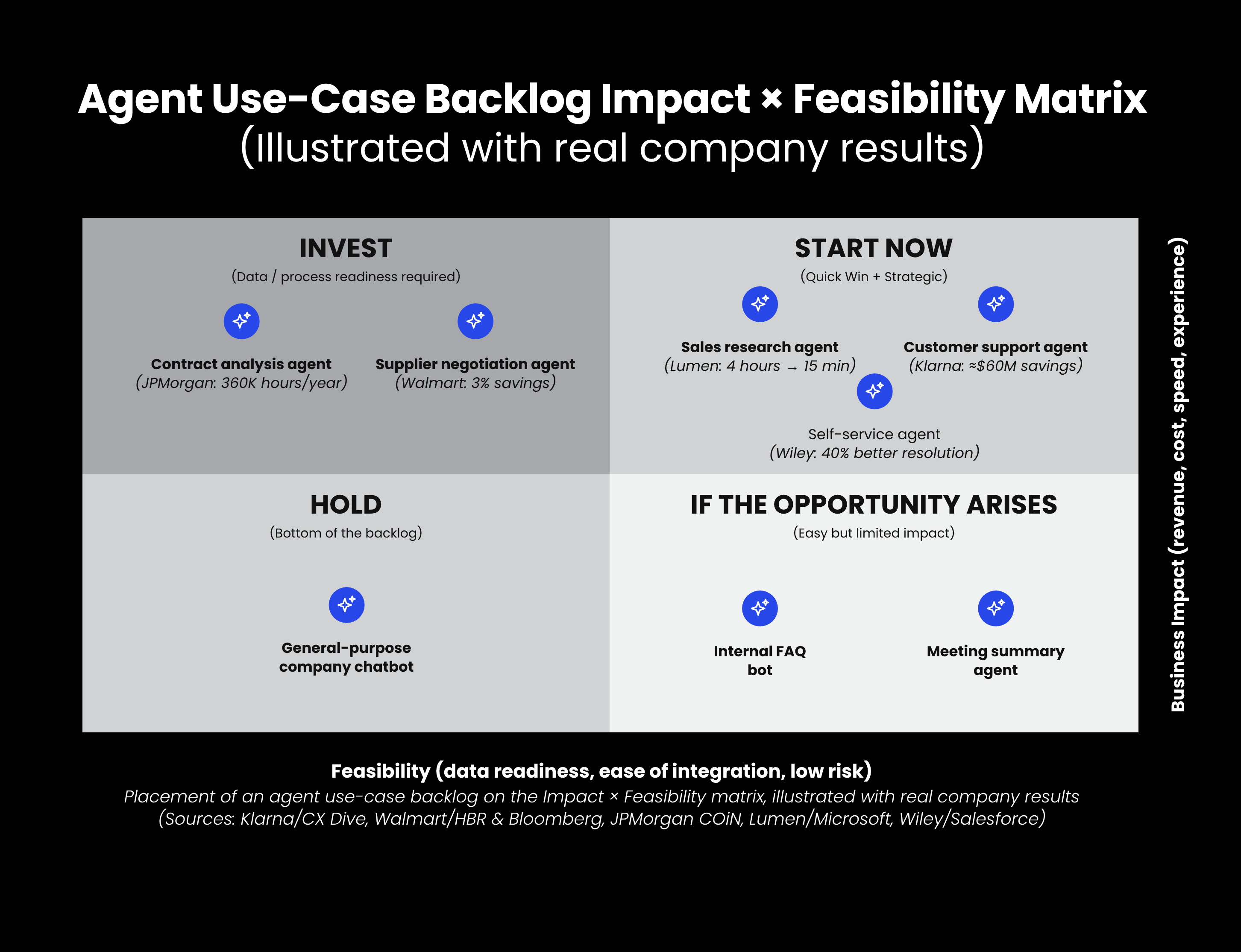
Reading the matrix is simple, but it takes discipline:
- Start Now (top right): High impact, high feasibility. Your first 90 days should be spent here. Klarna’s customer support agent and Lumen’s sales research workflow are textbook examples of this quadrant.
- Invest (top left): High impact, but the data, process, or trust infrastructure isn’t ready yet. Walmart’s negotiation agent started this way: first with a three-month controlled pilot involving the legal, finance, and procurement teams. For these, don’t launch an agent directly; start a readiness project first.
- If the Opportunity Arises (bottom right): Easy, but limited impact. A good training ground for the team to learn; don’t mistake it for strategy.
- Hold (bottom left): The bottom of the backlog. Don’t delete these — rescore them when conditions change.
Real-World Evidence: Agents in End-to-End Workflows
When looking for inspiration for your backlog, don’t focus on a single task in a single department; look at an entire workflow. The five stories below share one trait: the agent doesn’t just speed up a step, it carries the flow from start to finish.
Klarna — From customer request to resolution: Fintech giant Klarna’s AI assistant handles roughly two-thirds of customer conversations end to end: it understands the request, checks the account, executes the transaction, and closes the conversation. Average resolution time dropped from 11 minutes to under 2 minutes; by the end of 2025, the company was citing $60 million in savings and a capacity increase equivalent to 853 full-time employees. But in my view, the second half of the story is more instructive: when the human team was cut too aggressively, quality dropped on complex cases, and Klarna partially reversed course, moving to a hybrid model. The lesson is clear — the agent scales first-level volume, while humans move up the value chain.
Walmart — From supplier negotiation to signature: Walmart deployed an autonomous negotiation agent (Pactum) for the thousands of “long-tail” supplier contracts that human buyers never have time for. The agent takes the budget and targets, conducts the negotiation with the supplier itself, and closes the deal. The result: agreements with 68% of suppliers approached, average savings of 3%, payment terms extended by an average of 35 days — and negotiations that used to take weeks now take days. Most striking of all, three-quarters of suppliers reportedly said they preferred negotiating with the agent over a human :)
JPMorgan — From contract to insight: The bank’s COiN system scans 12,000 commercial loan agreements a year, extracting 150 critical data points per document in seconds. The same work previously consumed 360,000 hours of lawyer and loan officer time annually, and error rates fell by 80%.
Lumen — From research to customer contact: At telecom company Lumen, a seller’s research and preparation workflow before a customer meeting used to take an average of 4 hours; with an AI-powered workflow, it now takes 15 minutes. The company’s CRO says the 4 hours saved per seller per week translates into $50 million in annual value. Here, the agent compresses not a single task but the entire “research → summarize → prepare proposal → reach out” chain.
Wiley — From problem to self-service resolution: To manage demand spikes during back-to-school periods, publishing giant Wiley built a service agent (Agentforce) that handles account access, password resets, and payment routing end to end. Compared with its old chatbot, the company reports an improvement of more than 40% in case resolution, 50% faster onboarding for seasonal representatives, and a 213% return on investment.
The common pattern: the greatest value emerges where the agent owns a workflow, not just a task.
Keeping the Backlog Alive
The biggest mistake is to build the backlog once and bury it in a PowerPoint deck. Agent technology gains significant new capabilities every quarter, if not every month; a use case you deemed “not feasible” six months ago may have moved to the top-right quadrant today.
Three simple rituals are enough: a monthly scoring update (have new model capabilities changed feasibility?), a quarterly harvest meeting (what new use cases have emerged from what we’ve learned from agents in production?), and ruthless termination criteria (any pilot that can’t prove its value hypothesis within 90 days is shut down).
Six Lessons for Leaders
- Take inventory before choosing technology. Which model you’ll use is a meaningless question until you know which work you’ll hand over.
- Prioritize boring value over impressive demos. The best first use cases are usually the least glamorous. JPMorgan’s longest-running agent success isn’t a chatbot but a system that reads contracts; Walmart’s is the long-tail supplier contracts no one was looking at.
- Put data readiness at the center of feasibility. Most agent projects fail not because of the model, but because of messy, inaccessible data.
- Give every use case a business owner. The backlog is a tool for business leaders, not IT; the business unit is accountable for the value hypothesis.
- Manage the backlog like a portfolio. Quick wins build trust and momentum; strategic investments build lasting advantage. A portfolio that doesn’t carry both is unbalanced.
- Move people up the equation. This is Klarna’s costly lesson: when the agent took over first-level volume, the human team wasn’t a cost to be eliminated but an asset to be redirected toward complex cases and customer relationships. Use cases designed with an “elevate, not replace” mindset are the ones that last.
Closing
Within the next few years, every company will have an agent portfolio. What will set companies apart won’t be who runs the most agents, but who chooses more accurately which work to give them.
So the real question is this: while your competitors debate “which AI tool should we buy,” when will you start re-inventorying your organization’s work through the eyes of an agent?
Explore Our Related Training Programs




Comment(s)