
From Zero to a Company in 72 Hours: What an Agentic Organization Looks Like

Three engineers in San Francisco stepped in front of the cameras with no plan at all.
No idea, no name, no product. All they had was an AI agent platform and 72 hours.
At xAI/SpaceXAI’s Grok Bot Galaxy event, Matt Palmer, Lauren Tan, and Roshan Sadanani spent those three days building a company live on stream to show what Grok Bot can do. I followed the experiment day by day. In this post I won’t retell the chronology. Instead, I’ll focus on the most interesting part of the experiment: how three people, working with dozens of AI agents, built an organization that actually worked. What happened shows much more than the founding of a gaming company. It is a small-scale, fast-forward version of an agentic organization.
What Happened in 72 Hours (In Brief)
- Day 1: A search for an idea from scratch. The core infrastructure was set up (Slack, GitHub, Vercel, domain), and the team settled on a pop-up restaurant experience.
- Day 2: Feedback from agents working through the night changed the idea completely. The team pivoted from a restaurant pop-up to a game studio where bot templates became game characters.
- Day 3: The product was simplified (by “unshipping” features) and went live as ThursdayArena.com. Real users started playing, and the ad system started making money.
By the end of the three days, there was a real product with thousands of matches played, roughly 2,000 registered users, and working payment and ad infrastructure. But the real subject of this post isn’t the product. It’s the organizational structure that produced it.
The Agentic Org Chart
Day by day, the three humans built teams of specialist agents that took on the functions of a traditional company.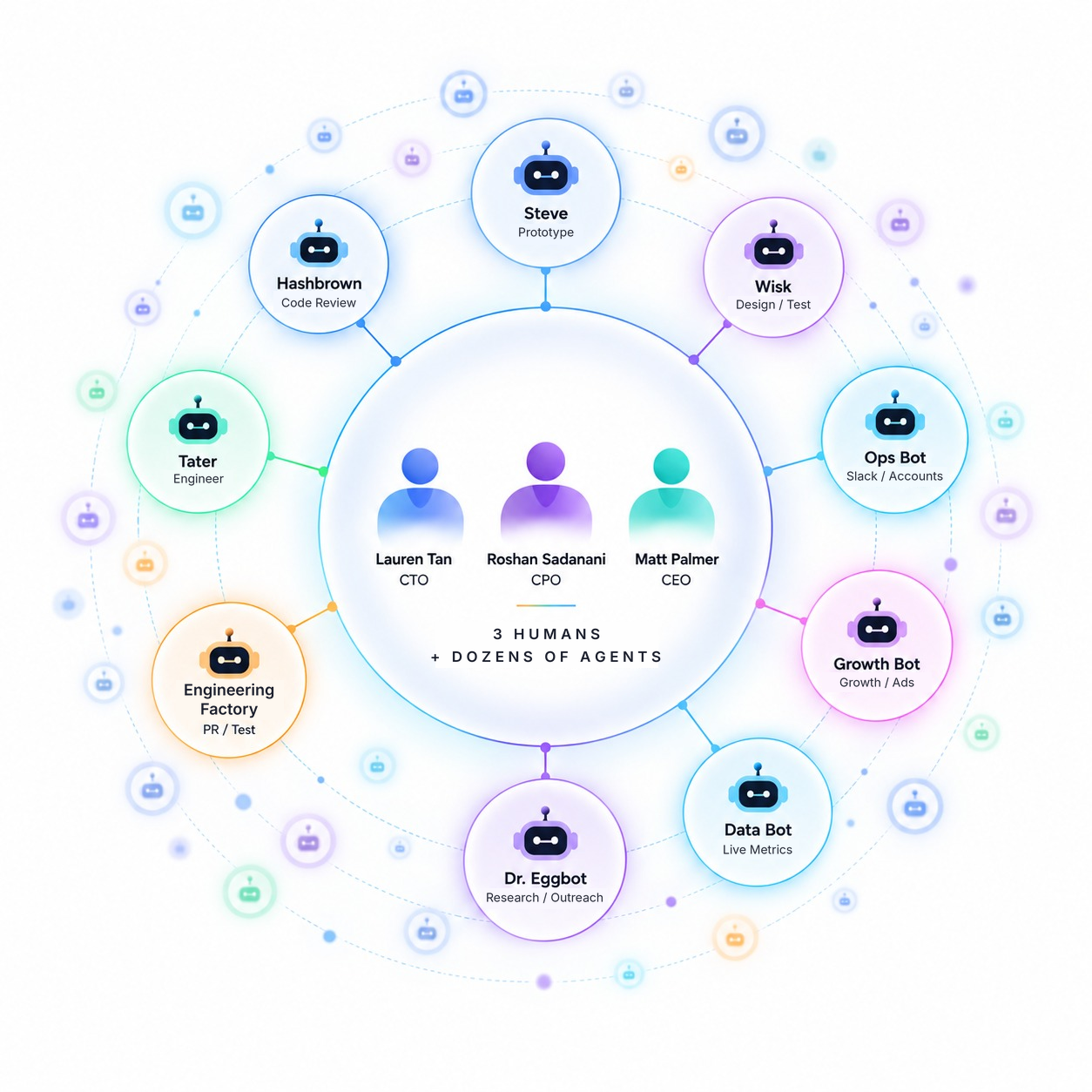
Three structural features stand out:
- Layered responsibility. Each human leader had one or more specialist bots “reporting” to them in their own area of expertise (engineering, product, operations), not the other way around. With clear roles, coordination worked as naturally as it does in human teams.
- Bots that spawn bots. Some agents, like Dr. Eggbot, had a single job: create new sub-agents (for research, outreach, testing) as needed. The organization could grow on its own without waiting for human approval.
- A self-optimizing layer. Lauren’s “engineering factory,” a loop of bots that wrote PRs, tested them, fixed bugs, and auto-approved, ran without human intervention. At one point, the team even asked their bots to “find the bottlenecks in our workflow,” and the bots analyzed their own organization and reported back.
“I don’t know how many Grok Bots we have anymore.” — Roshan Sadanani, at the end of Day 3
The team started Day 1 with three bots. Three days later, they could no longer keep track of their own agent count.
Why It Matters: The Numbers
This wasn’t a toy experiment. It had real outputs:
- Three people shipped a product that went from idea to real users in 72 hours.
- By the end of Day 3, the product had about 30,000 page views, more than 6,000 matches, and roughly 2,000 registered users (granted, with over 600,000 people around the world watching the livestream, that wasn’t too hard).
- The team changed its entire business direction at least once along the way (restaurant → game studio). A pivot decision that would take weeks at a typical startup was made and executed overnight.
For comparison: with a traditional team structure (a product manager, a few engineers, a marketer, maybe an operations specialist), this work would probably have taken weeks. Here it took 72 hours. The only thing that made the difference was an army of agents that three people learned to manage.
My 4 Takeaways for Business Leaders
- Organizational design is becoming independent of headcount. Team size is no longer limited by “how many people can we hire?” but by “how many workflows can we clearly describe to agents?” With the right agent architecture, small teams can produce far more, far faster, than large ones.
- More agents don’t help without clear focus. The team succeeded because each human leader set up their agents with clear goals in their own domain. Agents that knew where they were going, but could figure out the how on their own, created value without needing human management. That made it easy for humans and agents to stay aligned on creating shared value.
- Build systems that review themselves. Agents spotting their own bottlenecks, making improvements, and restructuring accordingly played out like a true agile organization in practice. In agentic organizations, fluid structures that quickly reshape themselves around changing market needs accelerate scaling.
- Speed lowers the cost of pivoting, but it demands discipline. Business agility here meant a business model could change in a single day based on signals from agents working overnight. But that speed only became an advantage because the team made clear decisions about what they would not do (unship) instead of trying to do everything. Otherwise, it would have just produced chaos.
Closing
The real message of Bot Galaxy wasn’t about building a gaming company. It was about showing that three people, with an army of agents that kept growing and managing itself, could do what a traditional organization does, and maybe do it faster.
How many “agent employees” does your organization have today? And would you know how many it has three days from now?


Comment(s)