01 · single source of truth

Every agent working in the company checks Modus before it moves on.

Rules do not stay in people's heads and scattered documents. The company's living digital business rules sit in one place; people and agents look at the same model.

  1. Business rules

    How the work runs: thresholds, due dates, tolerances, priorities.

  2. Boundaries

    What an agent may do and what it must never do; red lines.

  3. Decision rights

    Who makes which decision; which one the agent makes, which one goes to a person.

  4. Exceptions

    When, and with whose approval, you step outside the rule.

02 · why it is different

The business side builds the model, not the technical side. Agile, not waterfall.

technical and waterfall

  • A big model is designed first, then put into use.
  • Technical teams draw the ontology; the business approves it afterwards.
  • It ends on delivery day and goes stale as the work changes.

modus · business and agile

  • It starts from the company's modus operandi, from its business rules.
  • It is built in agile cycles; every sprint adds records to the model.
  • It emerges with the transformation and keeps evolving.

03 · product family

Three products, one value proposition: the living digital twin.

You can start with one and add the others as your needs grow.

  • modus engine

    Company Brain

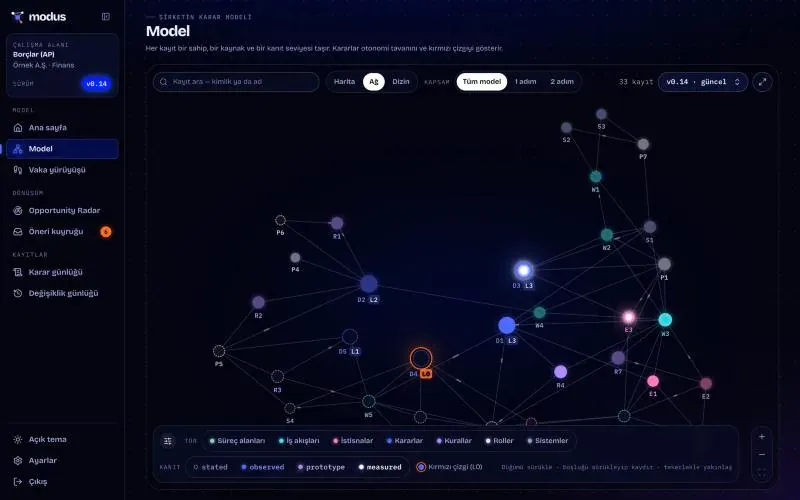
    The engine of the company model. It keeps the workflow, rule, decision, role, exception and system definitions in one place; your agents work by looking at this model.

    Modus Engine: the connection network of the company model
    • workflow
    • rule
    • decision
    • exception
    • role
    • system
  • modus transformation

    The transformation team's product

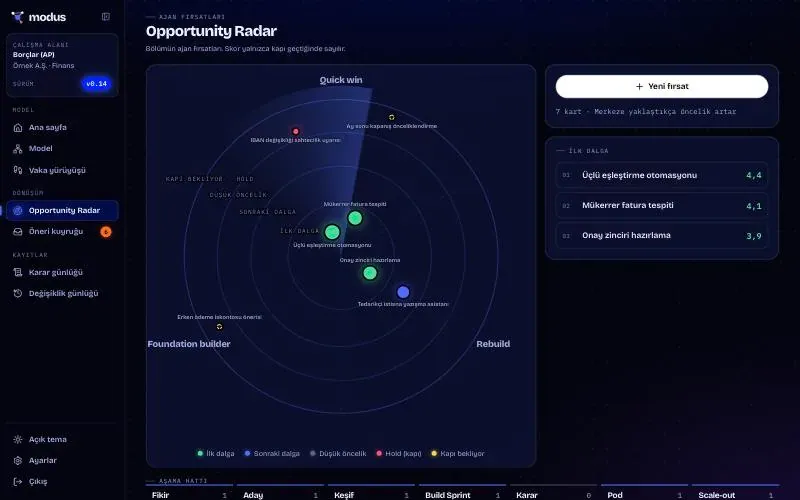
    The workspace where transformation teams build and run the Company Brain. Opportunity Radar, the transformation backlog, assessment and Build Sprint in one place; offered on a membership basis together with consulting.

    Modus Opportunity Radar screen: opportunities on a radar by score and wave
  • modus bi

    The interface that sees the model

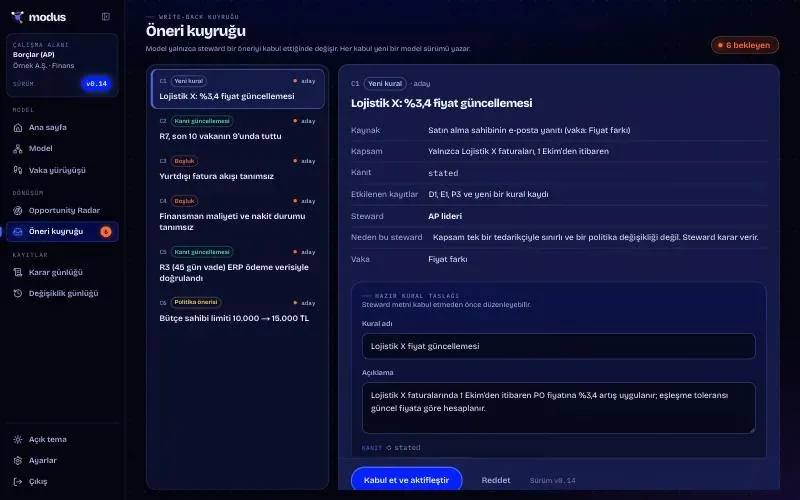
    The interface that shows the contents of the Company Brain to managers and teams, and lets you save and update it through an API. Everyone sees the company's model from the same place.

    Modus BI: new rule and evidence update records in the proposal queue

See Modus in your own workflows.

Request a demo

04 · inside the product

The company's way of working, as a model that agents can rely on.

  1. model

    Every record has an owner, a source and an evidence level.

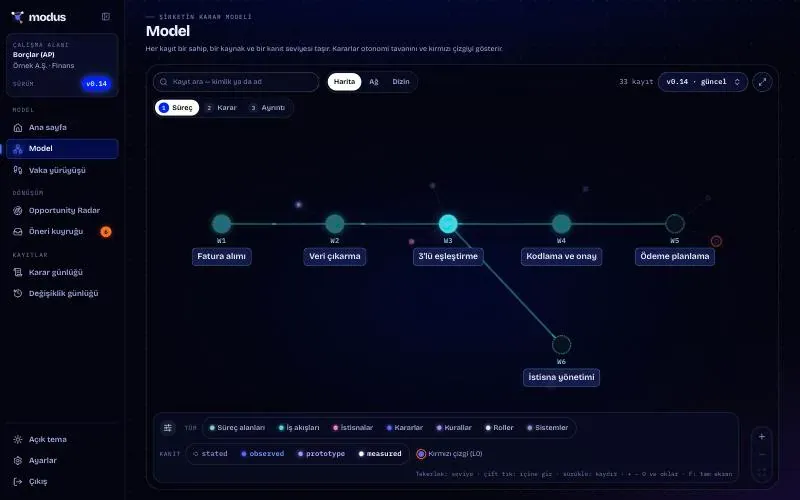
    Workflows, decisions, rules, roles and systems on one map. Decisions show the autonomy ceiling; red lines show the limit an agent can never cross.

    Model screen: the process map
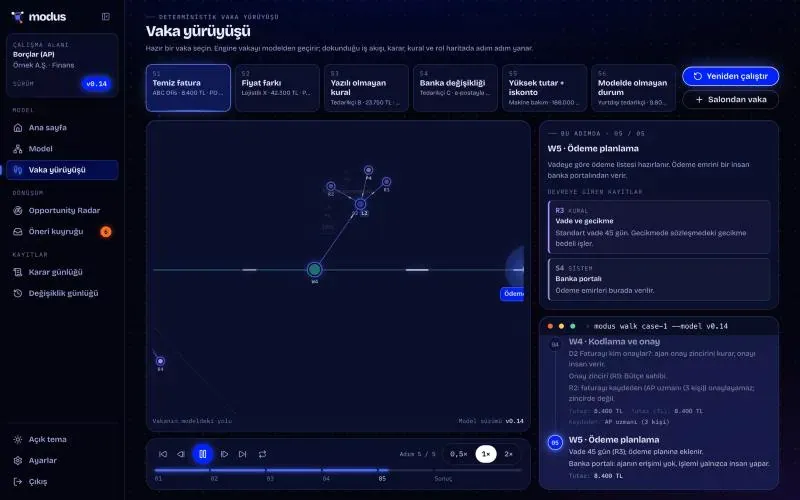
  2. case walk

    See step by step how a case moves through the model.

    Run a ready-made case: follow at every step which rule, which decision right and which exception kicked in, and why.

    Case walk screen: an invoice case moving through the model step by step
  3. opportunity radar

    Score agent opportunities and split them into waves.

    Once opportunities pass the gate they are ranked by a weighted score; the first wave, the next wave and low priority are clearly visible.

    Opportunity Radar screen
  4. modus bi · proposal queue

    New rules and evidence updates enter the model with your approval.

    Every proposal comes with its source, scope and owner. The model does not change until the steward accepts; every acceptance writes a new model version.

    Proposal queue: new rule, evidence update and gap records

The screens are taken from a demo workspace prepared with fictional company data.

Let's talk about which business unit to start with.

Request a demo

05 · how it works

The model is born with the transformation and grows with every sprint.

  1. 01

    The transformation starts

    In a business unit you choose, you work with ACM consultants in agile cycles.

  2. 02

    The model emerges

    Workflows, rules, decisions and exceptions are entered into the model with their owner and evidence.

  3. 03

    Agents look at the model

    Agents work by reading their boundaries and decision rights from here.

  4. 04

    The model lives

    What is learned in each sprint returns to the model; the digital twin stays current with the work.

early access

Let's build your company's digital twin together.

To see Modus in your own workflows, request a demo.

Get in touch

Please do not write personal details such as a phone number or e-mail address.